- IVAN HUG
- Posts
- The Math Behind $50K-$500K Career Gaps 📊
The Math Behind $50K-$500K Career Gaps 📊

Ivan Hug
December 15, 2025
Part 1 of 3: Seeing Your Career as a Unified System
Over the past seven weeks, we've explored 20+ frameworks—from the Product-Price-Place-Promotion-People model to psychological positioning strategies. We've examined each piece separately.
Now, in this three-part synthesis, we connect everything: how these elements interact, where the leverage points hide, and why your career outcomes depend less on competence and more on system alignment.
This is where it all comes together.
The Uncomfortable Truth About Your Career
Here's something that might sting a little: You've been operating your career like an employee when you should be running it like a CEO.

Wait, let me rephrase that.
You are running a business—you just don't know it yet. And that gap in awareness? It's costing you somewhere between $50,000 and $500,000 over your career lifetime. Maybe more.
If you've followed this series from the beginning, you've likely realized that the "Career Marketing Mix" isn't some clever metaphor I dreamed up to sound smart. It's a description of economic reality—the actual machinery determining whether you earn $120,000 or $220,000 for doing essentially the same work.
The Employee Mindset vs. Economic Reality
Most professionals operate with what I call the "Employee Mindset."
They believe that if they work hard (Product), they will be rewarded (Price). They view their career as a linear accumulation of skills and years—each certification another brick, each promotion another step up the ladder.
This mindset feels safe. It feels fair. It feels like how the world should work.

But here's the uncomfortable truth: The market doesn't reward merit. It rewards value. And value isn't a function of the product alone—it's a function of the entire system.
Think about that for a second. Two professionals with identical skills, identical work ethic, identical output—one earns double the other.
Why? Because one understood the system; the other just worked harder.
In this synthesis, we stop looking at the 5Ps—Product, Price, Place, Promotion, and People—as separate tactics you deploy when job hunting.
Instead, we reveal what I call the "Architecture of Value": how these elements interact to create exponential returns. When aligned, they create a competitive moat that makes you rare and expensive. When misaligned, they create the "Competence Trap," where you are genuinely excellent but chronically undervalued.
You are no longer an employee waiting to be discovered. You are a business owner managing a complex system. And just like any business owner, you need to understand how your system actually works.
I. The System Architecture: Understanding Your Value Chain
The 5Ps aren't a menu of independent choices where you pick and choose based on mood. They form a sequential value chain—a system where each element builds on the previous one.
Here's what most people miss: A failure at any step breaks the chain, rendering success at the other steps completely irrelevant.
Let me walk you through this.

Product First: The Foundation Nobody Wants to Build
You cannot market what you cannot define.
Seriously—stop right now and try to articulate in one sentence what expensive problem you solve and for whom. If you're struggling, you've just discovered why your career feels stuck.
The most common error I see—and I've coached many professionals through this—is trying to "promote yourself" before understanding your specific differentiation. You attend networking events, update your LinkedIn profile, maybe even hire a resume writer.
But until you answer the fundamental question—What expensive problem do I solve? For whom?—promotion just amplifies confusion.

Think about it. Would you market a product you couldn't describe? Would you launch a business without knowing what you're selling? Of course not.
Yet professionals do this with their careers constantly, wondering why they're not getting traction.
Price Second: The Signal Everyone Reads
Price isn't just what you're paid. It's a heuristic for quality that operates at a psychological level most people don't consciously recognize.

You must set your price anchor before you enter the market. Here's why: A professional who internally anchors at $150,000 signals a different tier of quality than one anchored at $120,000—even before they open their mouths.
This shows up in how you negotiate, which opportunities you pursue, even your body language during interviews.
Price frames the perception of the Product. The market treats a $120K professional differently from a $180K professional, regardless of actual skill differences. One gets invited to strategic planning meetings; the other doesn't. One is asked for opinions; the other for outputs.
This isn't fair, but it is predictable.
Place Third: The Channel That Changes Everything
Once you have a Product and a Price, you must identify where that combination commands premium returns. This is where most career strategies completely fall apart.
A premium Product fails in a discount market. Period.
You can be the best strategic thinker in a cost-center function, but the function itself caps your value. You can be brilliant in a dying industry, but the industry's decline drags you down.
Place determines whether your Product is a "Ferrari in a showroom" or a "Ferrari in a junkyard"—same car, radically different outcomes.
The brutal truth? Sometimes the highest-leverage move isn't learning a new skill—it's changing the channel entirely.
Promotion Fourth: The Engine That Amplifies Reality
Here's where things get interesting. Visibility amplifies the reality created by the first three Ps. But—and this is critical—it amplifies whatever reality exists.

If your Product is weak, Promotion kills you faster by exposing that weakness to more people. If your Product is strong but in the wrong Place, Promotion generates noise without results.
Promotion works only when the system is aligned—when you're promoting a differentiated Product, at the right Price, in the right Place.
Think of Promotion as an amplifier. You wouldn't turn an amplifier to maximum volume if you're playing static, right? Yet professionals do exactly this when they start "personal branding" without first building the underlying value architecture.
People Last: The Moat That Protects Everything
Finally, the People layer protects the system from market disruption. Your ecosystem isn't just nice to have—it's infrastructure.
Your weak ties determine access to better Places before jobs are even posted. Your strong ties validate your Price through social proof and referrals. Your ecosystem visibility amplifies your Promotion through network effects.
Without this layer, you're constantly starting from zero, competing in open markets against everyone else.
The professionals who seem to effortlessly move between opportunities? They built the People layer years ago. They're not luckier—they're better connected.
II. The Super-Relationships: Where to Apply Pressure
The real power of this framework isn't in understanding the individual Ps—it's in understanding their interactions.
After analyzing hundreds of career trajectories, the data reveals three "Super-Relationships" that drive the majority of career variance.
A. The "Ferrari in a Junkyard" Effect (Product × Place)
Let me share something that might surprise you: Context matters more than content. Way more.
Your career value equation is multiplicative, not additive:
Product Quality × Distribution Effectiveness = Career Value
This means that being great in the wrong place produces worse outcomes than being good in the right place.

Consider the actual data: A Senior Data Scientist in San Francisco (a high-density cluster) has access to 847 relevant opportunities within 50 miles. A peer with identical skills in Cleveland has 67 opportunities.
The San Francisco professional earns $305,000 on average; the Cleveland peer earns $130,000.
Read that again. Same skills. Same work ethic. Same technical capabilities. One earns more than twice the other.
This isn't a skill gap (Product)—it's a distribution gap (Place). You cannot "skill up" your way out of a bad Place. If you're in a discount channel—a dying industry, a cost-center function, a low-velocity region—the highest-ROI move isn't to get another certification.
It's to change the channel.
Moving from a "support function" to a "revenue function" can instantly double your value without you learning a single new technical skill. I've watched this happen repeatedly. The person doesn't change; the context does. And suddenly opportunities, compensation, and trajectory all transform.
Here's another uncomfortable truth: Visibility creates pricing power in ways that competence alone never will.
Recruiters and hiring managers engage in what behavioral economists call "satisficing"—they choose the safest option, not necessarily the best one. In blind tests, recruiters choose the "well-known candidate" 61% of the time over the "more qualified candidate."

Think about what this means for your career.
Being the best isn't enough if nobody knows it. Price is a proxy for quality, but Visibility is the proof of demand. You cannot price what is invisible—buyers can't pay a premium for value they don't know exists.
The data here is striking: A 40% increase in visibility (through speaking, writing, or external presence) often translates to a 20-30% increase in lifetime earnings.
Why? Because visibility reduces the buyer's perceived risk. When a hiring manager sees your name on conference programs or cited in articles, they're not thinking "This person is showing off." They're thinking "This person must be legitimate—other people trust them."
What most people call the "Modesty Tax"—that reluctance to self-promote—is really the cost of your invisibility. And that cost compounds over decades.
C. The "Weak Tie Bridge" (People × Place)
You cannot arbitrage Places without People. This is perhaps the most underappreciated leverage point in career strategy.

Your strong ties—close friends, colleagues you see regularly—occupy the same "Place" as you. They know the same jobs, the same information, the same opportunities.
To change your Place (industry, geography, or tier), you need Weak Ties—those acquaintances you see 2-4 times a year.
Network science shows that 76% of career-changing opportunities originate from weak ties. These people are "bridges" to ecosystems you cannot see from your current position. They know about opportunities before they're posted. They can provide introductions that bypass standard application processes. They validate your credibility in new contexts.
Optimizing for network diversity (People) is the most efficient way to access new distribution channels (Place). Yet most professionals focus exclusively on deepening existing relationships rather than systematically building bridges to adjacent ecosystems.
Implementing this system requires navigating three conflicts that every professional faces. The good news? These aren't random—they're predictable.
The bad news? You cannot avoid them. You must choose.
1. Safety vs. Differentiation (The Product Tension)
Here's the conflict: Being "well-rounded" feels safe because you fit more job descriptions. Being "specialized" feels risky because it narrows your market.
But here's the reality: Safety is risk in slow motion.
In a globalized market where your competition includes millions of professionals worldwide, "generalist" equals "commodity." The market pays for scarcity, not abundance. Being "good at everything" means you're special at nothing—and special is what commands premiums.

You must be willing to "kill" previous versions of yourself to become specific. That comfortable breadth you've built? It's protection against short-term risk while creating massive long-term vulnerability.
The resolution: Choose differentiation. The risk of being "too specific" is far lower than the risk of being "easily replaceable." Every year you delay this choice, you're training the market to see you as interchangeable.
2. Comfort vs. Trajectory (The Place Tension)
High-opportunity Places—industry hubs, startups, high-growth firms—are expensive, competitive, and uncomfortable. Low-opportunity Places are comfortable and affordable.

You cannot have both simultaneously in the early phases.
The reality: Opportunity concentrates. You cannot have the trajectory of a Silicon Valley executive while prioritizing the comfort of a low-cost lifestyle in Phase 1 of your career. The math simply doesn't work.
The resolution: Optimize for trajectory early; lifestyle later. Pay the "Place Tax" (higher costs, more competition, less comfort) in your 20s and 30s to build the capital and network that allow you to dictate your lifestyle in your 40s and 50s.
Reverse this sequence, and you'll likely regret it.
3. Authenticity vs. Visibility (The Promotion Tension)
Self-promotion triggers real social pain. It activates the same neural circuits as physical pain. "Imposter syndrome" isn't just a metaphor—it's your brain genuinely uncertain whether you have the right to claim the value you're claiming.

But here's the reality: Invisibility is not humility. It's bad business.
If you have a solution that genuinely adds value, hiding it is a disservice to the market. The people who could benefit from your expertise never find you because you're too uncomfortable promoting yourself.
The resolution: Reframe promotion from "bragging" to "demand generation." You're not screaming "Look at me." You're signaling "Here is the solution to your problem."
Dramaturgy—the intentional presentation of self—is not dishonesty. It's strategic communication.
IV. The Unifying Principle: Context Is King
After 22 articles exploring these dynamics, we arrive at the deepest insight, and it's deceptively simple:

Competence is a commodity; positioning is the leverage.
For the first 5-7 years of your career, competence is the primary driver. You must be good at what you do—there's no substitute for fundamental skills.
But once you cross the threshold of "proven competence," the ROI shifts dramatically.
Improving your skills by another 10% requires massive effort—thousands of hours, expensive training, intense focus—for marginal gain. But improving your Positioning (Place, Promotion, People) by 10% requires strategic choice and yields exponential returns.
Think about this practically.
Moving from good to excellent as a project manager might take 2,000 hours of deliberate practice. Moving from a cost-center function to a revenue function takes one strategic job change—maybe 100 hours of networking and interviewing.

Same improvement in market value, radically different investment.
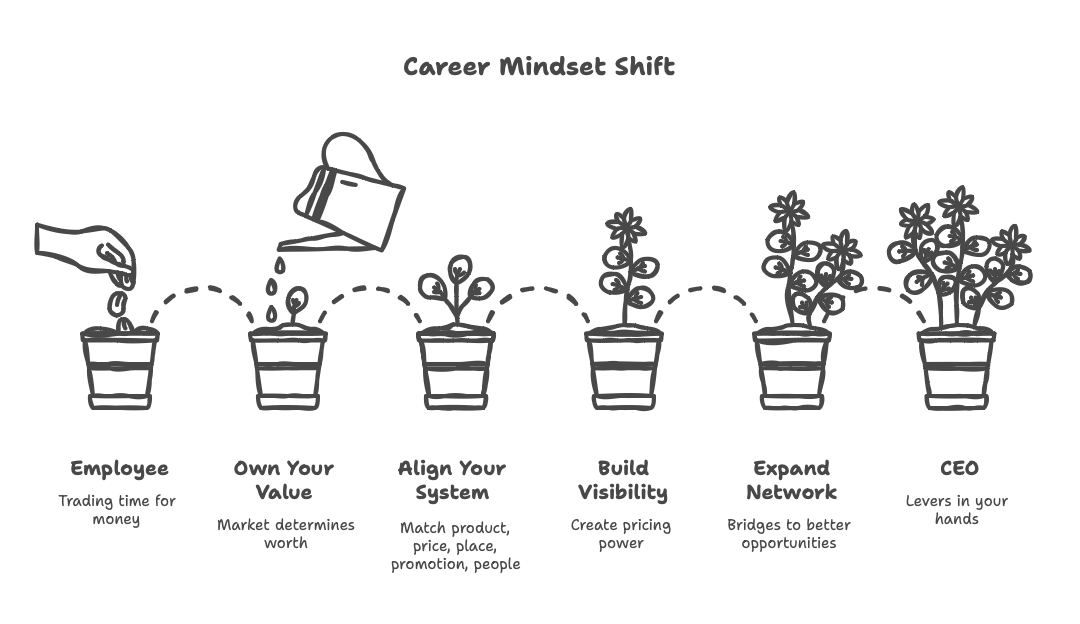
This represents a fundamental shift in mindset:
Employee Mindset: "I trade time for money. My boss determines my worth. If I work harder, I'll be rewarded."
Product Mindset: "I own a business of one. The market determines my worth based on the value I create and how well I position it. I engineer my own demand."
The Beautiful Truth
This framework is amoral. It doesn't care about fairness or what "should" happen. It rewards alignment—matching your Product, Price, Place, Promotion, and People into a coherent system that the market can recognize and value.
If you're underpaid, it's not (usually) because the world is unfair or your boss is a jerk. It's because your system is misaligned.
You're selling a premium product in a discount place, or you've set your internal price anchor too low, or you haven't built the visibility that creates pricing power, or your network doesn't include bridges to better opportunities.
The beautiful thing about this realization? These are solvable problems.
Unlike many career challenges, you don't need permission to fix them. You don't need your boss's approval to reposition yourself. You don't need your company's blessing to build visibility or expand your network.
You are the CEO of your career. The levers are in your hands.
The question is whether you'll pull them.
Next in Part 2: The Execution Playbook—specific tactics for diagnosing your system misalignment and the 90-day plan to fix it.
What's the biggest misalignment in your career system right now—Product, Price, Place, Promotion, or People? Hit reply and let me know.

