- IVAN HUG
- Posts
- Netflix figured this out. Satya Nadella figured this out. When will you?
Netflix figured this out. Satya Nadella figured this out. When will you?
Ivan Hug
November 26, 2025
Netflix didn't just change what people watched.
They changed how content reached customers.
When Reed Hastings ditched video stores for streaming, he wasn't switching products. He was redefining the distribution model entirely. Today, Netflix has over 301 million paying subscribers across 190 countries.
The product—entertainment—stayed the same.
The distribution channel became the competitive advantage.
The Uncomfortable Truth Nobody Tells You
Here's what keeps me up at night after 30+ years watching careers unfold across different industries.
Your career operates exactly like Netflix.
You're not just choosing what work to do. You're choosing how your value reaches the market.
Most professionals never realize they're making distribution decisions that determine whether their premium capabilities reach premium opportunities—or get trapped in discount channels.
Think about that for a moment.
You could be the most talented person in your office. The hardest worker. The one who stays late, shows up early, and delivers every single time.
But if you're positioned in the wrong distribution channel?
You're essentially selling luxury goods at a dollar store.

The Math That Changed Everything
I used to think hard work was the answer. Put in the hours. Build the skills. Results would follow.
Then I started paying attention to the patterns.
The professionals who advance fastest aren't just working harder. They're working in positions where effort compounds because multiple distribution channels align to amplify rather than diminish returns.
They've cracked a code that most people don't even know exists.
Research from Iskamto's 2023 study revealed something that should make every professional pause: organizational culture contributes 26.6% to employee performance outcomes.
That's more than a quarter of your results determined by factors outside your direct control.
Let that sink in.
You could increase your personal productivity by 50%, and if you're in the wrong culture, you'd still underperform someone with average skills in the right environment.
Organizations with strong cultures experience up to 72% higher employee engagement than those with misaligned cultures. Highly engaged teams achieve 21% greater profitability.
The environment isn't just affecting your happiness—it's determining your economic value.
The Three Dimensions of Career Positioning
Your career position exists in three-dimensional space.
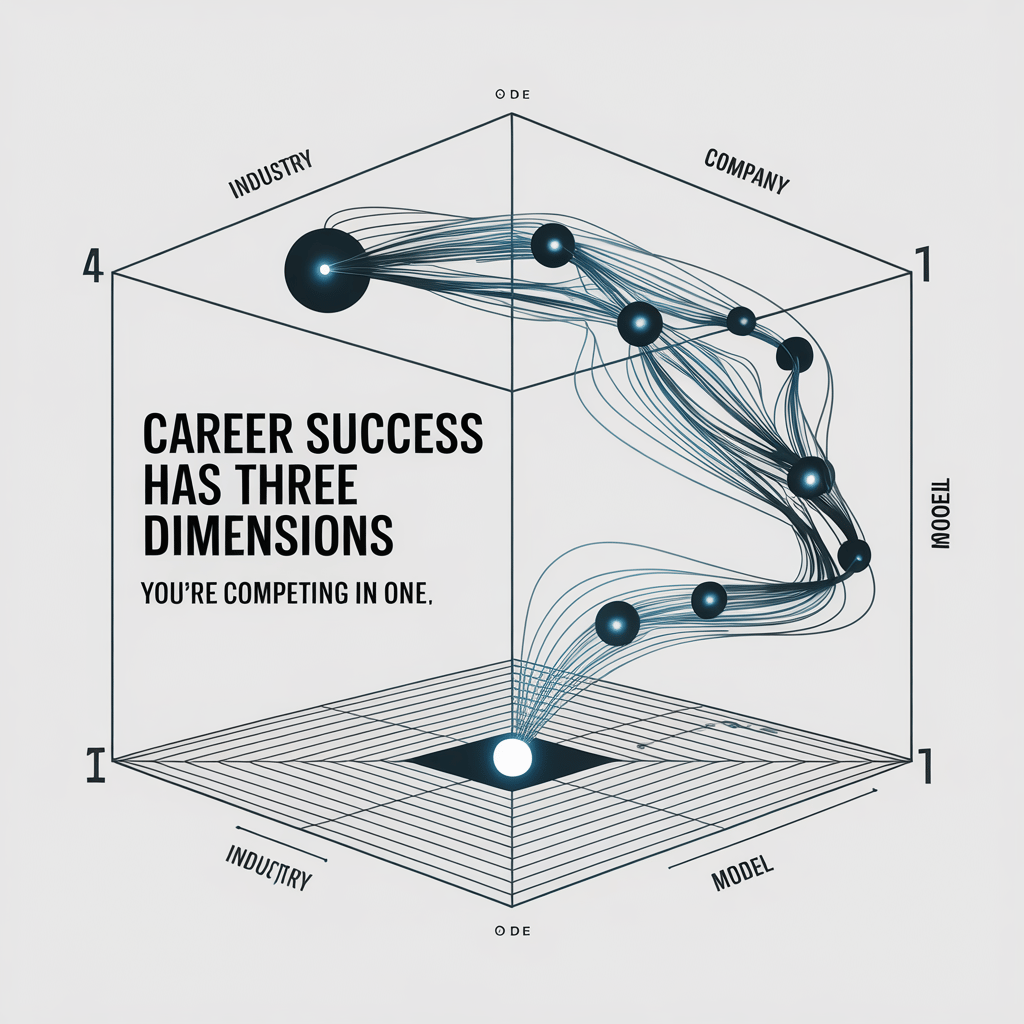
Industry dynamics form one axis. Company type forms another. Work model completes the picture.
Each dimension has its own logic, its own rules, its own reward structures. But they interact in ways that create exponential outcomes—positive or negative.
Think of it like mixing chemicals.
Hydrogen is flammable. Oxygen feeds fire. Combine them correctly and you get water—something entirely different from either component. Combine them incorrectly and you get an explosion.
Neither outcome is random. Both follow predictable laws.
Career positioning works the same way.
I've watched brilliant people work twice as hard for half the results. Not because they lacked talent. Not because they weren't committed.
Because they were fighting structural headwinds instead of riding structural tailwinds.
They were positioned in career distribution channels that diminished rather than amplified their value. And the frustrating part? Nobody told them.
They kept doubling down on effort when the problem was positioning all along.
The Satya Nadella Masterclass
Let me tell you about a guy named Satya Nadella.
In 1992, a young Indian engineer joined Microsoft. For the next 22 years, he moved strategically through the company—Online Services Division, Business Division, Server and Tools Business, Cloud and Enterprise group.
He didn't job-hop between companies.

He position-hopped within one.
Each move wasn't about chasing a bigger title or a fatter paycheck. It was about positioning himself at the intersection of emerging opportunities.
When cloud computing was still a curiosity, he was already leading the charge. When mobile became critical, he'd already built the relationships and expertise to matter.
When he became CEO in February 2014, Microsoft's market cap sat around $300 billion.
The company was struggling. Windows 8 had flopped. Internal politics ran rampant. Consumers and developers were losing faith. Many predicted Microsoft would become the next IBM—respected but irrelevant.
What happened next?
Under Nadella's leadership, Microsoft stock increased nearly tenfold. The company reached over $3 trillion in market value. Annual growth hit 27%. They became the world's most valuable company—not once, but repeatedly.
The same person. The same company. Different positioning, different results.
Nadella didn't just work hard. He positioned himself where multiple distribution channels aligned—the right company type, the right industry trajectory, the right work model.
Strategic positioning multiplied his impact exponentially.
His skills mattered. His work ethic mattered. But his positioning turned good into extraordinary.
Channel One: Industry Dynamics

Industries aren't static containers for careers. They're dynamic systems with different velocities, different reward structures, and different strategic logics.
Fast-moving industries—technology, media, consumer internet, venture-backed startups—operate at high velocity.
Products launch and die in months. Companies go from founding to IPO in years. You can leap from entry-level to senior leadership in five years instead of fifteen.
The tradeoffs are real, though.
Knowledge depreciation accelerates. Job security evaporates. Career half-lives compress. You need to reinvent yourself every few years or become irrelevant.
It's exhilarating and exhausting in equal measure.
Stable industries—healthcare, education, government, utilities—operate at lower velocity.
Products and services change slowly. Career progression follows predictable timelines. The ceiling might be lower, but the floor is higher.
But look at the data: Healthcare and social assistance is projected to add 2.2 million jobs in 2025 alone, making it America's fastest-growing sector. Professional, scientific, and technical services are expected to grow 10.5% through 2033.
Stable doesn't mean stagnant.
It means predictable growth with lower risk.
Channel Two: Company Type
Within industries, company type creates the second major distribution dimension.
A software engineer at a five-person startup, a 500-person scale-up, and a 50,000-person enterprise do fundamentally different work—even if their titles match perfectly.

Startups (1-50 employees) offer maximum learning velocity.
You'll do work outside your job description daily. Everything is improvised. Chaos is the operating system.
The advantage? You might learn more in one year than in three at a larger company. You'll wear seventeen hats and discover capabilities you never knew you had.
But let's be honest about the risks. Around 90% of startups fail. Even successful ones take seven to ten years to create big paydays. Your equity often becomes worthless.
The learning is real; the financial rewards are probabilistic at best.
Scale-ups (50-500 employees) occupy a unique sweet spot.
They've proven product-market fit but haven't ossified into bureaucracy. Systems are forming, not calcified.
You can go from individual contributor to director-level in two to three years because the company is growing faster than it can hire senior talent.
The ladder extends upward as you climb it.
Enterprise organizations (5,000+ employees) provide maximum stability, deepest resources, and most specialized roles.
The brand opens doors. The training programs polish you. The compensation is predictable. The pace is measured.
The Strategic Insight Most People Miss
Here's what the smartest career builders understand:
The best strategy isn't choosing the 'best' company type. It's sequencing different types across career stages.
Your twenties are for learning—take the startup chaos and compress a decade of experience into three years.
Your thirties are for leading—join the scale-up where you can rise with the tide.
Your forties are for leveraging—bring your battle-tested expertise to an enterprise that needs exactly what you've built.
Match your career stage to your company stage.
Channel Three: Work Model
The third dimension—how work gets done—has expanded from a single model to four distinct options in just the past five years.
Remote work offers maximum geographic flexibility.

About 40% of the global workforce now engages in remote or hybrid models. Remote workers report being up to 47% more productive than office-based peers. And 97% of remote workers would recommend remote work to others.
The World Economic Forum projects digital remote work to grow globally to 90 million positions by 2030—up from 73 million in 2024.
The trajectory is clear and accelerating.
But—and this is crucial—reduced visibility can slow advancement.
Here's the uncomfortable data: remote workers face 3.9% promotion rates versus 5.6% for in-office peers.
That's not a small difference. Over a decade, it compounds into dramatically different career trajectories.
If your work product speaks for itself and you're not optimizing for promotion, remote work offers the best lifestyle returns.
If you're gunning for the C-suite, think carefully about what you're trading.
The 90-Day Action Plan
Turning assessment into action requires discipline and honesty.

Step 1: Complete a six-dimension audit honestly.
Assess your current industry velocity, company type, work model, cultural alignment, growth trajectory, and skill-to-positioning ratio.
Most professionals overestimate their positioning because they've never thought systematically about these factors before.
Step 2: Identify your weakest distribution channel.
The weakest link limits your overall trajectory. You might have perfect industry positioning but terrible company type fit.
The constraint determines the outcome.
Step 3: Determine which dimensions you can change easily versus which require major transitions.
Some repositioning takes a weekend. Some takes two years. Know the difference before you start.
Step 4: Create a 90-day optimization plan for the easiest changes.
Build momentum with quick wins.
Step 5: Develop a 12-month strategic repositioning plan for major changes.
Rome wasn't built in a day, and neither is optimal career positioning.
The Part Nobody Wants to Hear
Here's what nobody wants to hear:
A moderately skilled professional in an optimally aligned position will outperform a highly skilled professional in a misaligned position.

Not because skills don't matter. Because distribution determines whether skills can create value.
I've seen it happen dozens of times.
The most talented person in the room, working fourteen-hour days, delivering exceptional work, getting passed over for promotions.
Meanwhile, someone with average skills but superior positioning glides into leadership roles.
They're not better. They're better positioned.
It's not unfair. It's physics. You can't swim upstream forever.
Most professionals spend 100% of career development time becoming better products—building skills, earning certifications, developing capabilities.
Almost none spend meaningful time on distribution strategy.
They polish the product endlessly while ignoring the shelf it sits on.
The Radical Recommendation
Flip your investment ratio.

Spend 70% of career development energy on positioning strategy.
Spend 30% on skill development.
Position yourself where multiple distribution channels align. Then develop capabilities that compound within that positioning.
Let the structure amplify your effort instead of absorbing it.
Your Move
Your career isn't just what you do.

It's where you do it, who you do it with, what industry dynamics amplify or constrain it, what company structure enables or limits it, and what work model optimizes or restricts it.
Distribution determines whether your premium capabilities reach premium opportunities—or get discounted by misalignment.
Netflix figured this out for entertainment.
Satya Nadella figured this out for his career.
The principles aren't secret. They're just rarely applied to the most important product you'll ever develop: your professional trajectory.
The question is: When will you?
What's Next
Have a 1-minute look at the video that has the key messages. It is here.
Now that you understand how to position yourself strategically, the next question becomes:
How do you price yourself within that position?
That's where we're heading next—from place strategy to price strategy.
Because getting the distribution right is only half the equation.
The other half is ensuring the market pays what your positioning is worth.
What's your biggest positioning challenge right now? Hit reply and let me know—I read every response.
If this landed for you, forward it to one person who needs to hear it. The best careers aren't built alone.
Join 16,000+ professionals who get weekly career insights that actually work. No fluff, just the strategies successful people use but rarely share.

