- IVAN HUG
- Posts
- 67% Work in the Wrong Place. Here’s the Audit.
67% Work in the Wrong Place. Here’s the Audit.

Ivan Hug
November 24, 2025
Your career isn't failing because you lack talent—it's failing because you're in the wrong environment. Organizational culture contributes 40% to your performance. Today: the three diagnostic questions that reveal whether you're positioned for success or slowly suffocating your potential.

I've spent 30+ years watching brilliant professionals throw away their best years in the wrong places.—I've seen the pattern repeat many times.
They're not failing because they lack talent. They're selling a premium product in a discount store.
Today I'm going to show you why your career environment matters more than your skills—and give you a practical framework to figure out whether you're in the right place.
The distribution delusion killing careers
Rolex doesn't sell watches in Walmart. Tesla skipped traditional dealerships entirely. Netflix walked away from video stores before destroying them.
These weren't product decisions—they were distribution strategies that determined whether premium offerings reached premium customers.
Your career is a premium product too. But here's the brutal question nobody's brave enough to ask: Are you selling it at a discount store?
The data is stark. Organizations with robust cultures show 72% higher employee engagement than those with misaligned cultures. Meanwhile, 67% of professionals work in environments that crush their value by 30-50%.

Not because they lack talent. Not because they're underqualified. Because they're in the wrong place.
And unlike that Rolex sitting in a display case—keeping its value no matter where it sits—your career performance can't be separated from where you work. You're dynamic. Your environment either amplifies what you bring or suffocates it.
Why we're optimizing the wrong thing
We obsess over résumés. Interview techniques. LinkedIn profiles. Certifications. These matter—but they're like debating the best packaging for a product you're selling in the wrong market.
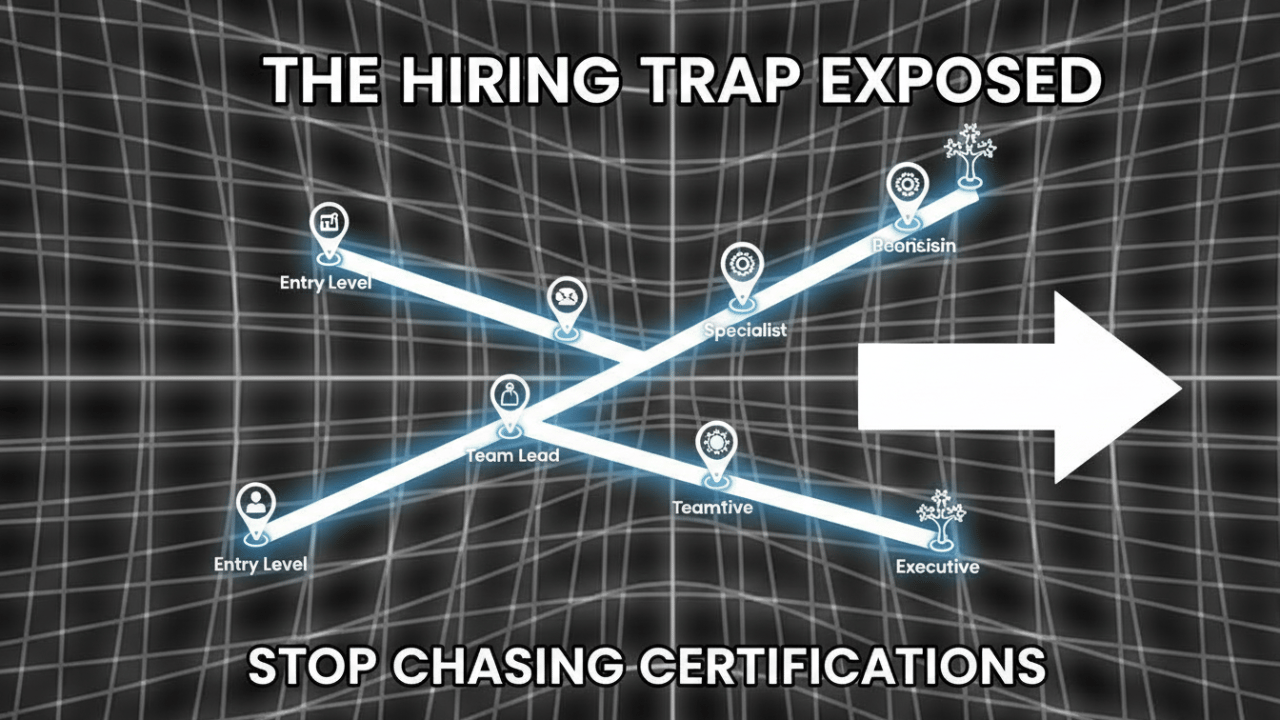
The career advice industry makes billions telling you to become "better." A better candidate. A better employee. A better leader.
What they conveniently ignore: Better at what? Better for whom? Better in which context?
Let me show you what I mean with two real examples.
Sarah works at a Fortune 500 bank. Top performer. Consistently delivers results in the 90th percentile. Recognized, promoted, well-compensated. By every measure, she's winning.
Michael? Average by most standards. Joins a fast-growing fintech startup. Within eighteen months, he's leading a team. Shaping strategy. Building systems from scratch.
Five years later, Michael has quadrupled his compensation and sits two levels higher than his résumé predicted. Sarah moved up one level, got standard raises, and feels increasingly trapped by processes and politics.
Different outcomes. Not because Michael was smarter or Sarah less ambitious. Because Michael was a Ferrari on a highway and Sarah was a Ferrari stuck on a dirt road.
This is the distribution delusion—believing career success comes mainly from personal attributes when organizational culture contributes 26.6% to performance, and that's just what we can measure. The real impact? Probably closer to 40% when you factor in everything research can't easily quantify.
You can be exceptional in the wrong place and underperform. You can be adequate in the right place and excel.
The three layers most people never see
Most professionals assess companies at surface level. Office aesthetics. Stated values. Free snacks. These are artifacts—visible stuff that tells you almost nothing about whether you'll thrive there.
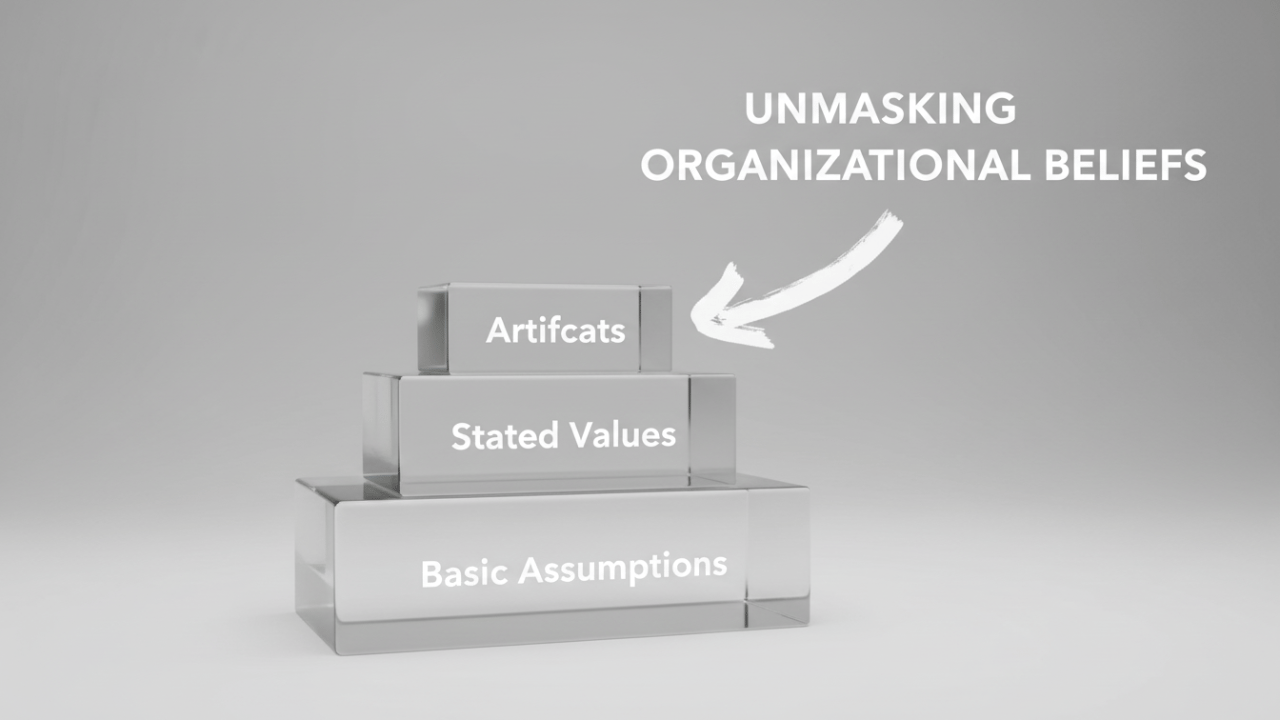
Culture operates at three levels, like an iceberg where 90% stays hidden underwater. Understanding all three determines whether you're making an informed decision or gambling blindly.
Layer 1: What you can see
Walk into Google's offices—playful spaces, casual dress, free food, game rooms. Walk into Goldman Sachs—formal attire, structured environments, hierarchy everywhere. These are artifacts.
The mistake? Assuming artifacts predict your experience. They don't. They're outcomes of deeper cultural assumptions, not causes. Two companies with identical artifacts can have completely different operating systems underneath.
Layer 2: What they say
Dig deeper and you hit stated values. Mission statements. Leadership speeches about "our culture." Here's where it gets interesting: there's often a massive gap between what companies say and what they actually do.
A company might talk about "work-life balance" while systematically rewarding 70-hour weeks. Another claims "innovation and risk-taking" while punishing anyone whose projects fail.
According to Built In's 2024 Culture Report, 61% of employees would leave their current job for a company with a better culture. Why? Because they've experienced this values-action gap firsthand.
The questions that matter: What gets people promoted here? What triggers criticism? What accomplishments earn recognition? The answers reveal lived values, which predict your trajectory far better than any mission statement.
Layer 3: What they believe
The deepest level consists of basic assumptions—unconscious, taken-for-granted beliefs shaping how work happens. They're invisible to most people inside the organization because they're the water everyone swims in.
These assumptions operate across several domains:
Time orientation—Does the organization optimize for short-term wins or long-term value?
Truth and reality—How are decisions made? Data-driven? Consensus-based? Authority-dictated?
Human nature—Does the organization assume people are naturally motivated or need close supervision?
These assumptions drive thousands of daily micro-decisions that compound into career trajectories. They're why two people with identical skills have radically different outcomes in different organizations.
The fit audit you need to run right now
Most professionals realize they're in the wrong role only after two years, when patterns become undeniable but switching costs have mounted. Smart approach? Conduct a career fit audit at three key moments—before accepting an offer, at six months, and again at eighteen months.

Three Diagnostic Questions:
Do my natural work rhythms match the organization's tempo?
Some organizations move fast—decisions in days, projects in weeks. Others move deliberately—decisions in months, projects in years. Neither is inherently better. But your natural tempo matters enormously. If you thrive on rapid iteration, a slow organization will frustrate you regardless of other factors. The mismatch drains energy because you're constantly working against your grain.
Do my decision-making preferences align with power structures?
How do you prefer making decisions? Data and analysis? Consensus and input? Intuition and speed? Now, how does the organization actually make decisions? There's often a massive gap between stated process ("we're data-driven") and actual practice ("the CEO decides based on gut feeling, then we find data to support it"). If you're analytical and the organization rewards political savvy, you'll excel at work no one values.
Do my communication patterns fit the information flow?
Are you direct or diplomatic? Organizations have communication cultures. Violating these norms, even unknowingly, creates friction that compounds over time. A direct communicator in a diplomatic culture gets labeled "abrasive." A diplomatic communicator in a direct culture gets labeled "unclear" or "political." Same behavior, different context, opposite outcomes.
Warning signs you're in the wrong place
You're in the wrong place when you observe these patterns consistently over three to six months:
Your strengths generate neutral responses while your natural tendencies trigger criticism
You find yourself suppressing instincts that succeeded in previous roles
You're working twice as hard for half the recognition, watching colleagues with lesser capabilities advance faster
Your Sunday evenings fill with dread—not because the work is uninteresting, but because managing misalignment leaves nothing for actual value creation
An alarming 74% of employees report feeling demotivated when working for an organization where they're a poor cultural fit. These aren't signs you need to change. They're signs you're in the wrong distribution channel.
Real companies getting it right
Southwest Airlines figured this out decades ago. They recognize that treating employees well creates happy customers, which drives financial success. Their employee-first culture isn't just talk.
When uniforms needed updating, they recruited flight attendants to design them. When customers compliment employees via social media, Southwest forwards every single one directly to the employee and their boss—over 7,000 monthly.
The result? When their call center moved from the Bay Area to Las Vegas, 80% of California employees relocated—for a $13-an-hour job. That's not compensation. That's culture.
Zappos takes it further. After an intense four-week training program, they offer new hires several thousand dollars to quit if the fit isn't right.
Only 2% take it. Because people who recognize misalignment early save themselves years of frustration, and Zappos saves the cost of a bad hire. It's brilliant distribution strategy—making sure only people who truly fit enter the system.
The data backs this up: companies with strong onboarding processes see a 70% improvement in productivity and an 82% boost in retention.
The strategic pivot playbook
If your career fit audit reveals systematic misalignment across multiple dimensions, you need a strategic pivot. Not rage-applying out of desperation, but methodically repositioning where your capabilities find better alignment.
The five-phase approach:
Secure your financial position. Build 3-6 months of expenses in liquid savings. This creates psychological safety to be selective rather than desperate.
Inventory transferable skills. What capabilities transcend your current context? Project management, stakeholder communication, technical expertise—these translate across environments.
Research target environments systematically. Use the three-layer cultural analysis. Talk to people inside those organizations. Observe how they describe daily reality versus official messaging.
Position your narrative. When interviewing, frame leaving around seeking better strategic fit rather than fleeing problems. Leaders respect professionals who understand themselves well enough to recognize misalignment.
Give yourself permission to prioritize fit over prestige. A 15% pay cut to join an environment where you'll thrive often yields better five-year outcomes than a 15% raise to join another misaligned culture.
What this means for your Monday morning
Here's what's happening right now that makes this critical.

According to SHRM, workers in positive organizational cultures are almost 4x more likely to stay with their current employer. On the flip side, 57% of those rating their culture poorly are actively looking for new jobs.
The market's tightening. According to Gallup, 51% of U.S. employees—roughly 1 in 2 workers—are either actively searching for or watching for new job opportunities. That's up from 44% in March 2020.
What's driving this? Culture misalignment. In 2024, 88% of workers said corporate culture is important when choosing where to work—a massive jump from previous years. Culture now often outweighs salary or perks.
The professionals who understand distribution strategy will have their pick. Those who don't will keep wondering why their careers aren't advancing despite all their "self-improvement."
Your action step for this week
Here's what I want you to do right now.
Pull out your phone. Set a reminder for this Saturday morning. When it goes off, spend 30 minutes honestly answering those three diagnostic questions:
Do my natural work rhythms match the organization's tempo?
Does my decision-making style align with how decisions actually get made?
Do my communication patterns fit the information flow?
If you're batting 3 for 3? Congratulations—stay exactly where you are and double down.
If you're 0 for 3 or 1 for 3? It's time to start building your pivot plan.
Because here's the thing nobody tells you: The best time to look for your next role is when you don't desperately need it. When you still have energy. When you can be strategic rather than reactive.
Your career is a premium product. Stop selling it in discount stores.
—
Quick question for you: Have you ever realized—too late—that you were in the wrong environment? What was the turning point that made you see it? Hit reply and share your story. I read every response.
Until next time..

