- IVAN HUG
- Posts
- 30+ Year Veteran's 4-Circle Method: How to Build Career-Changing Professional Networks
30+ Year Veteran's 4-Circle Method: How to Build Career-Changing Professional Networks

Ivan Hug
December 04, 2025
The Morning Brew Insight: Your Career Is an Ecosystem
Apple is worth $2.8 trillion. Not because they make the best phones—Samsung and Google make excellent phones too. But Apple orchestrates something fundamentally different: ecosystems.
Every iPhone strengthens relationships with developers, suppliers, retailers, media companies, and evangelistic customers. Each transaction multiplies across millions of devices. This isn't product strategy. This is relationship architecture at scale.
Your career works identically.
Yet here's the brutal data: 85% of jobs get filled through relationships, but 67% of professionals have no systematic strategy for building them. They're playing hope and hustle—hoping the right person shows up, hustling when opportunities appear.
Meanwhile, 58% report that traditional networking feels exhausting and transactional. So they avoid it entirely.
The professionals who thrive? They understand something fundamental that Morning Brew's founders embedded into Beehiiv's DNA: strategic ecosystem design compounds like interest.
Your Brain Has a Hard Limit (And It's Destroying Your Strategy)
Quick question: How many meaningful professional relationships can you actually maintain?
Your gut says "hundreds" or "as many as I need."
Your brain says "about 150."
British anthropologist Robin Dunbar discovered this in the 1990s. Your neocortex—the part handling complex social relationships—has a hard limit. Beyond roughly 150 people, connections become shallow. Names without context. Faces without stories.
This isn't a character flaw. It's your hardware.
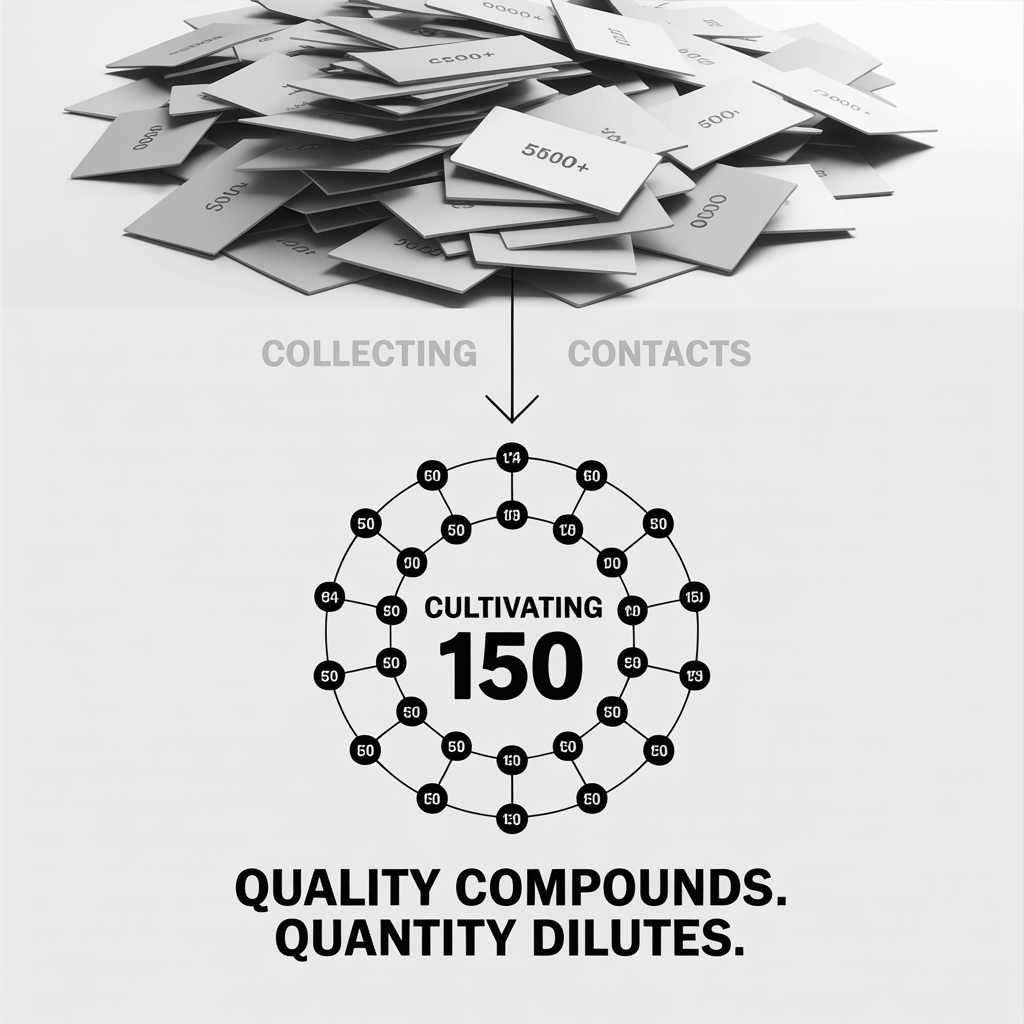
Yet 89% of people maintain 500+ LinkedIn connections while cognitive science shows you can sustain deep relationships with 150 maximum.
Think about that for a second.
LinkedIn's business model depends on you believing bigger is better. Collect contacts like Pokémon cards. Five hundred connections! A thousand! Ten thousand!
But every connection beyond 150 dilutes your actual relationship capital.
The strategic implication changes everything: your career strategy shouldn't be about collecting contacts. It should be about cultivating your 150 with surgical precision.
A 2024 McKinsey workforce study revealed that professionals who intentionally curate their 150-person network advance 3.2 years faster on average than those who collect connections passively.
That's not a small edge—that's the difference between director at 35 versus 38, VP at 42 versus 45.
Time compounds. Relationships compound faster.
The Four-Circle Architecture That Actually Works
Understanding your 150-person limit is just the beginning. The real power comes from structuring those 150 relationships across four concentric circles.
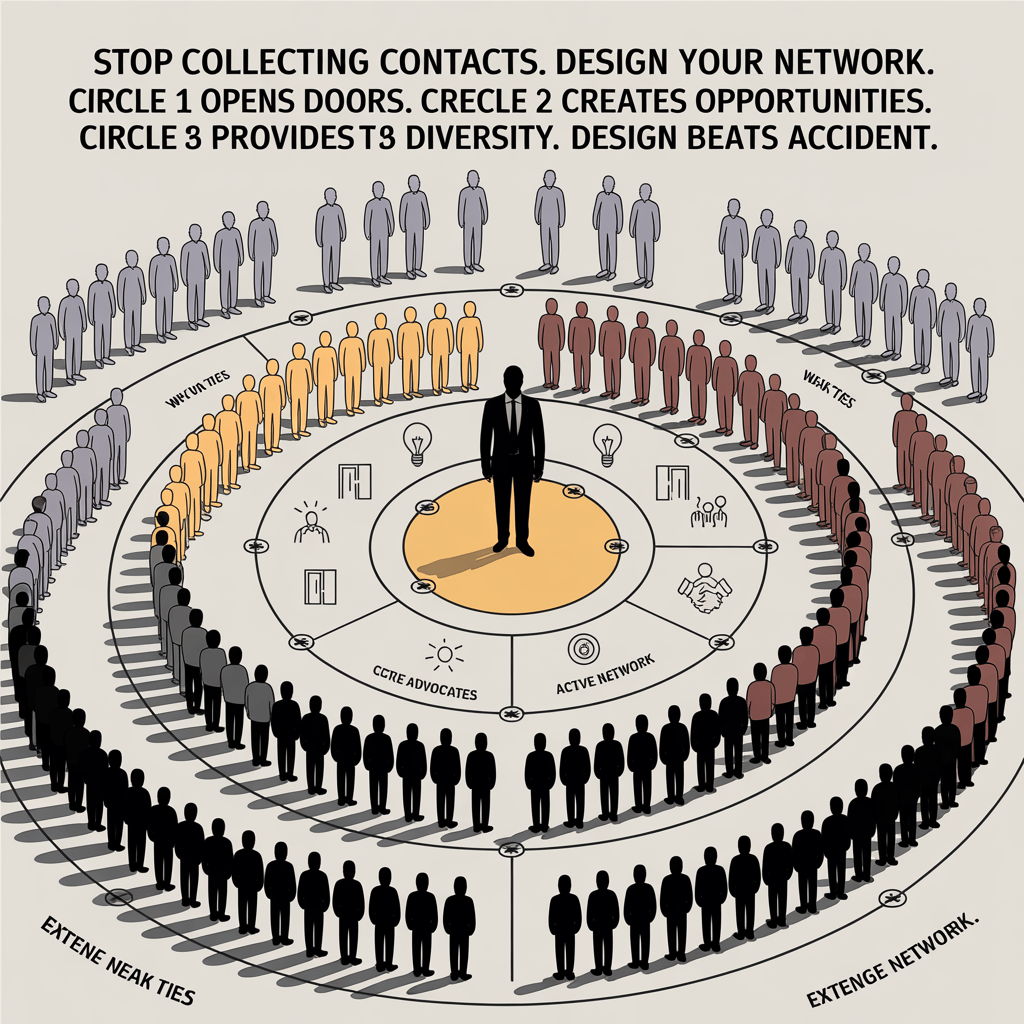
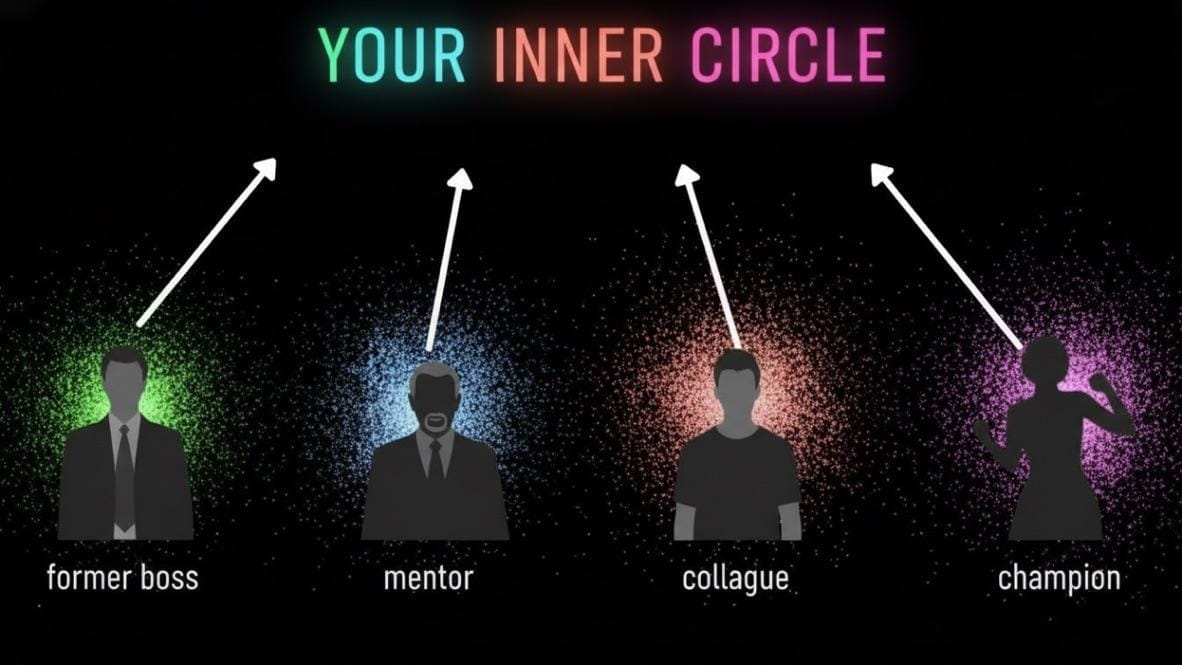
Circle 1: Core Advocates (10-15 people)
These are your champions. Former bosses who'd rehire you immediately. Colleagues who became genuine friends. Mentors who've invested deeply in your growth.
This circle builds your reputation. When someone asks "Do you know anyone who...?" these people say your name first.
Here's the uncomfortable question: how many people are in your Circle 1 right now?
If you're like most professionals, you can count them on one hand. That should concern you.
Careers don't move in straight lines. They move through inflection points. And inflection points happen when someone in Circle 1 opens a door.
Consider Sarah Chen's story. After 12 years in pharmaceutical sales, she wanted to transition into biotech operations. Her resume screamed "wrong background." But a former manager—her Circle 1—had moved to a biotech startup. One conversation led to an introduction. Three weeks later, she had an offer at 20% above her previous salary.
The job never appeared on LinkedIn. It was filled before the posting went live.
That's Circle 1 in action.
Circle 2: Active Network (40-60 people)
These are your professional allies. You're not grabbing coffee weekly, but you maintain genuine connection. You comment meaningfully on their achievements. You share relevant opportunities. You remember their kids' names.
This circle creates opportunities before they hit the open market.
Most professionals neglect Circle 2 because these relationships don't feel urgent. Big mistake.
A Stanford Graduate School of Business longitudinal study found that 76% of career-changing opportunities come from Circle 2 relationships—not Circle 1 (too similar to you) or Circle 3 (too distant).
Circle 2 is where serendipity lives, but serendipity only shows up if you've laid groundwork.
Circle 3: Extended Network (80-90 people)
These are meaningful connections from past roles, conferences, projects. You're not in regular contact, but genuine mutual respect exists.
This circle provides diversity. Different industries. Different geographies. Different functional areas. They see patterns you miss. They know opportunities you'd never discover independently.
The best part? Circle 3 requires minimal maintenance—maybe two thoughtful messages yearly. But when activated, this circle punches way above its weight.
Circle 4: Weak Ties (Beyond 150)
Sociologist Mark Granovetter's research revealed something counterintuitive: career-changing opportunities often come from peripheral connections, not close friends.
Why? Because your close connections know what you know. They move in your circles. They see the same opportunities you see.
Weak ties bridge different networks. They connect disparate worlds.
Why Networking Makes Your Skin Crawl (The Neuroscience)
The word "networking" makes you think of awkward cocktail parties and fake LinkedIn connections.

Here's why traditional networking fails: it treats relationships like business transactions. You meet someone at a conference. Exchange business cards. Send a connection request with a generic message. A month later, reach out asking for an introduction.
What just happened? You triggered what sociologists call "balanced reciprocity"—the transactional mode that exhausts everyone involved.
Your contact's brain immediately activates an internal calculator: "What have you done for me? What do I get from this?" Even if they help, the relationship starts in deficit.
There's a different way. Call it "generalized reciprocity."
You help someone today without expecting immediate payback. Maybe they help you next year. Maybe they help someone else who eventually helps you. Value flows throughout the network without direct exchanges.
This isn't soft skills fluff. This is evolutionary biology.
Your brain evolved sophisticated trust mechanisms over millions of years. In ancestral environments, trusting the wrong person could get you killed. Modern brains still screen every professional interaction for threat signals.
That cold LinkedIn message? Your recipient's amygdala flags it. Cortisol spikes. Their guard goes up. You've just made it harder, not easier, to build that relationship.
Here's the neurological reality: when someone trusts you, their brain releases oxytocin—the same chemical that bonds parents to children. Oxytocin makes people want to cooperate with you. It reduces the psychological cost of helping you.
But you can't fake your way to oxytocin release.
A 2023 Harvard Business School study tracking 3,000 professionals over five years found something remarkable. Those who practiced generalized reciprocity—giving without scorekeeping—built networks 40% larger and reported 2.3x higher job satisfaction than transactional networkers.
The professionals who master networking don't try to trick the system. They work with their biology, not against it.
The Transaction Trap (And Your Escape Route)
You meet someone at a conference. Exchange contact information. Send a connection request with a generic message. A month later, reach out asking for an introduction.
You've just triggered balanced reciprocity—the transactional mode that exhausts everyone.
Here's the alternative. The ecosystem builder approach.
You meet someone at a conference. Have a genuine conversation about their work. Later that week, send a personalized message referencing your conversation and sharing an article relevant to their current project. No ask. Just value.
Three months later, you see a job posting perfect for someone in your network. You connect them—no strings attached.
Six months after that, you share an insight your new connection would appreciate. Still no ask.
Then, a year later, you reach out about an opportunity where you could genuinely collaborate.
They say yes. Because you've been making deposits into the relationship account without tracking the balance. You've demonstrated generalized reciprocity. You've signaled that you're playing the long game.
This approach requires patience. In a world obsessed with quarterly results and instant gratification, patience is your competitive advantage.
A 2024 LinkedIn analysis of 50,000 successful job transitions found that professionals who practiced generalized reciprocity for 12+ months before needing their network received offers 60% faster than those who activated dormant networks during job searches.
The time to build relationships is before you need them, not when you're desperate.
Your Attachment Style Is Sabotaging Your Network (Here's How to Fix It)
Here's something that'll surprise you: networking feels natural for some people and excruciating for others because of patterns developed before age five.
Attachment theory from developmental psychology offers an unexpected answer. Your early relationships with caregivers created internal working models—unconscious templates shaping how you approach professional relationships throughout life.
Secure attachment (roughly 50% of people): You're comfortable with both autonomy and connection. You reach out without overthinking. You ask for help without feeling needy.
If this is you, relationship building probably feels relatively natural.
Anxious attachment (roughly 20% of people): You crave connection but fear rejection. You might over-invest in relationships, checking in too frequently. Or you avoid outreach altogether, convinced you're bothering people.
If this is you, networking events feel especially draining. You're managing two conversations—the external one happening in reality and the anxious internal dialogue questioning every interaction.
Avoidant attachment (roughly 25% of people): You prioritize independence and self-sufficiency. Asking for help feels like weakness. Building relationships feels like obligation.
If this is you, you might have an impressive resume but a limited network. You've succeeded despite your relationships, not because of them. That strategy has an expiration date.
Here's the good news: attachment styles aren't fixed. They're learned, which means they can be relearned.
The first step? Simply recognizing your pattern.
The second step? Design relationship strategies that work with your style, not against it. Anxious attachers thrive with asynchronous communication—email and thoughtful LinkedIn comments that remove real-time pressure. Avoidants excel at "value-first" approaches that feel less vulnerable—sharing insights publicly, making strategic introductions, offering expertise without asking for anything in return.
The Maintenance Myth That's Costing You Opportunities
Here's something that'll relieve you: strong professional relationships don't need weekly maintenance.
Really.
The anxiety about "I haven't reached out in three months, now it'll be awkward" is mostly in your head.
Research on relationship maintenance shows that quality matters far more than frequency. One deeply thoughtful interaction every six months beats twelve shallow check-ins.
The key is intentionality. When you do reach out:
Make it personal. Reference something specific about them or their work. Show you've been paying attention.
Provide value without asking for anything. Share a relevant article. Make a useful introduction. Offer a genuine compliment about their recent achievement.
Be human. Skip the corporate-speak. Write like you talk.
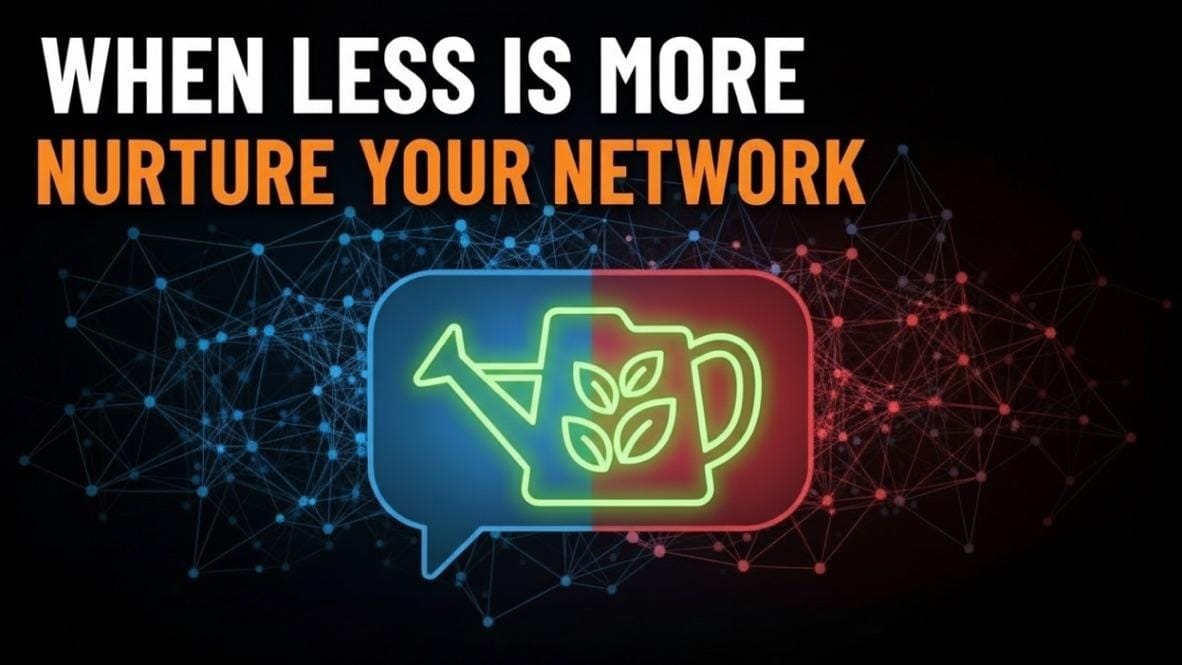
Think of your professional ecosystem like a garden. You don't water every plant every day. You maintain awareness of what needs attention when. You tend to each plant according to its needs.
The Personalization Advantage Nobody's Using
Here's the irony of modern professional networking: everyone's trying so hard to be "professional" that they become interchangeable.
The LinkedIn messages all sound the same. The coffee meetings follow the same script. The follow-ups could've been written by the same person.
Behavioral science reveals something fascinating: people remember what makes you different, not what makes you same.
I learned this the hard way. Early in my customer success career, I tried fitting the polished consultant mold—formal, predictable, forgettable. My network grew slowly because I was interchangeable with thousands of other professionals.
Then I started being myself in professional contexts. Mentioning my mechanical engineering background when discussing project management. Referencing insights from beekeeping—yes, beekeeping—when talking about complex systems. Being honest about failures instead of only highlighting successes.
You know what happened? People started remembering me. Not just remembering—reaching out months later because something I'd said had stuck with them.
Your authentic quirks aren't obstacles to professional relationships. They're your signature. They're how people file you in the "memorable" category instead of the "generic professional" folder.
The Compound Effect You Can't Afford to Ignore
Building a strategic professional ecosystem isn't urgent. You won't see results tomorrow. You probably won't see dramatic results next month.
That's exactly why most professionals never do it systematically.
But here's what the data shows: professionals with well-cultivated networks earn 20-30% more over their careers, experience 40% less unemployment, and report significantly higher job satisfaction.
More importantly? They have more career options.
When change happens—and in today's economy, change always happens—they're not starting from scratch. They're activating an ecosystem they've been cultivating all along.
Your resume will get you in the room. Your skills will help you perform. But your ecosystem? That's what opens doors you didn't know existed. Creates opportunities you couldn't have predicted. Builds a career that's resilient to whatever comes next.
The question isn't whether you'll need these relationships. The question is whether you'll have built them before you need them.
Your 90-Day Ecosystem Audit
Stop reading. Grab a pen or open your notes app.
List ten people who've significantly influenced your career in the past three years. Don't overthink it—just write names.
Now ask yourself:
How many of these relationships did you deliberately cultivate versus stumble into?
How many of these people would you feel comfortable calling with a professional challenge?
How many have you proactively helped in the past six months?
If you're like most professionals, you'll notice something uncomfortable. Your most valuable professional relationships happened to you. You got lucky with a great boss. You sat next to someone interesting at an event. You worked on a project with the right person at the right time.
That's not a strategy. That's chance.
The professionals who consistently advance don't wait for serendipity. They architect their ecosystems deliberately.
Start now. Start small. Start deliberately.
Your future self will thank you.
Three Questions for Your Reflection This Week(end)
1. What would change in your career if you spent the next 90 days deliberately cultivating your Circle 1 instead of collecting new contacts?
2. Which of your 150 slots are occupied by people who aren't serving your growth—or whose growth you aren't serving?
3. If your industry experienced disruption tomorrow, which three people in your ecosystem would you call first—and would they answer?
Share your ecosystem audit results in the comments. What surprised you most about your current network structure?
If this resonated, forward it to someone in your Circle 1. They'll appreciate you thinking of them.
P.S. Next, I'm breaking down why the professionals earning 40% more aren't necessarily working harder—they're working through better strategic frameworks. The framework that transformed how I approached client relationships will surprise you.

