- IVAN HUG
- Posts
- 200 Milliseconds. That’s How Fast Your Body Reads a Liar.
200 Milliseconds. That’s How Fast Your Body Reads a Liar.
Ivan Hug
February 11, 2026
Last month, a colleague showed me a deal.
Beautiful deck. Clean numbers. Three VPs signed off.
My chest tightened. I told her: Something's off.
I couldn't name a single flaw. Not one broken number. Not one red flag I could defend in a meeting room.
Three weeks later, the whole thing fell apart—in exactly the way I'd sensed but couldn't explain.

That wasn't magic. That was 30+ years of pattern recognition doing its job 400 milliseconds before my conscious brain caught up.
Your brain sees before your words catch up
Here's what academic theory does well: it finds universal rules. Builds models. Creates frameworks that look great on whiteboards.
Real value there. But a hidden cost, too.
The moment you generalize, you lose the specific. And reality lives in the specific. |

Bruce Lee put it bare: "If you learn concepts, if you work for information, then you don't understand. You only explain."
Read that again. Explaining is not understanding.
You can explain why a deal looks risky using finance models. Lay out the risk factors. Build a coherent argument.
But understanding—the kind that makes your body tense before your mind finishes processing—comes from seeing versions of this story before. From living the 3 a.m. panic calls. The half-executed pivots. The stakeholder rage no contract anticipated.
Those accumulated patterns sit in your nervous system now. Not just your prefrontal cortex.
Gavin de Becker, who spent decades studying threat assessment, calls this "intuition"—but strips the mysticism. Intuition is your brain doing high-speed pattern recognition based on years of exposure.
Your gut processes dozens of micro-cues—tone shifts, hesitations, the gap between what someone says and how they sit—and reaches a conclusion faster than conscious thought.
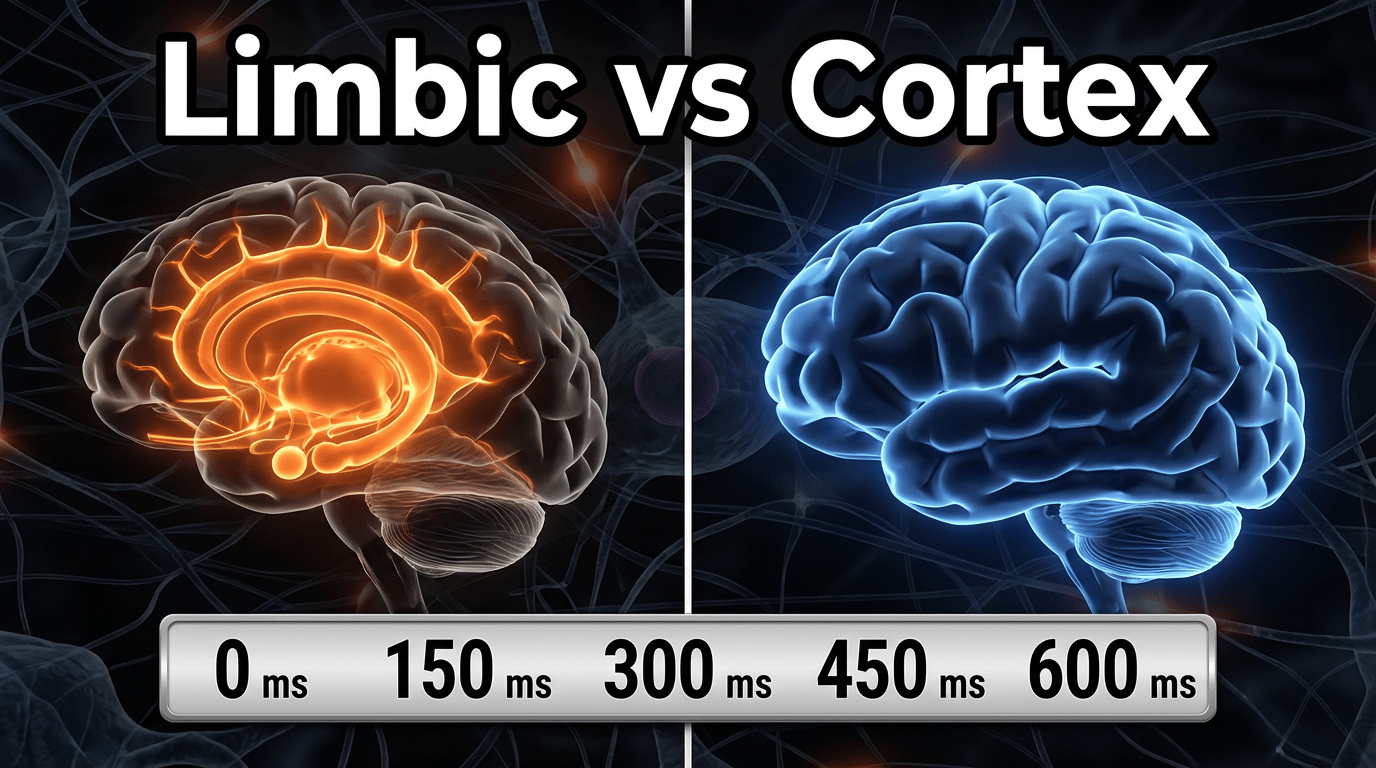
Joe Navarro, ex-FBI counterintelligence, measured it: your survival brain reacts in 200 milliseconds. Your thinking brain takes 600. That 400ms gap is where most professionals lose their edge—they override the faster, smarter signal because they can't justify it in a slide deck.
A story from the field
I watched this play out during a banking transformation I led. The team had built a flawless migration plan—every dependency mapped, every risk scored, every timeline signed off by three stakeholders. On paper: bulletproof.
But the lead engineer kept pulling at his collar. He agreed with every line item. He just... hesitated. Half a beat too long between "yes" and the next topic.
I'd seen that hesitation before. In different rooms. In different industries. It always meant the same thing: I see a problem I don't know how to name yet.
I called a pause. We dug in. Turns out there was a dependency buried three layers deep that nobody had mapped.
If we'd gone live on schedule, we'd have bricked a core banking system serving 400,000 customers. The hesitation saved us. The spreadsheet almost killed us. |
Your life is the lab—you are the experiment
In academia, theory sits on top. In the real world, you flip that pyramid. You are the experiment.

Bruce Lee's working method: "Research your own experience. Absorb what is useful, reject what is useless, and add what is essentially your own."
That's not poetry. It's a methodology. In my 20+ years across consumer goods, banking, transportation, and tech, I've watched it play out the same way:
Your experience is data. Not anecdotal. Not "just a feeling." What you observe, test, and verify in actual work matters more than what any authority claims should work.
Test everything on yourself. A productivity system isn't "good" because a famous CEO swears by it. It's good for you if you run it for six weeks and see results.
Discard what fails. Even if it's in a bestseller. Even if your mentor built their career on it. If it doesn't produce results in your context, it's dead weight.
This is why experienced managers often break textbook rules—and still win. They've run the experiment. They know that generic advice fails with this team in this situation. They play by principles, not scripts.
Failure is feedback, not identity
Here's where this gets uncomfortable.
Experience-based wisdom demands you treat failure not as a reflection of competence, but as data about what doesn't work.
Lee wrote: "Defeat simply tells me that something is wrong in my doing; it is a path leading to success and truth."
An engineer's mindset applied to life. When a strategy fails, you don't spiral. You ask: What assumption was wrong? What did I miss? What changes next time?
De Becker's The Gift of Fear is built on cases where people ignored intuition—and paid for it. Not moral tales. Empirical warnings. People who overrode their gut because they didn't want to seem rude, suspicious, or paranoid suffered consequences their instincts tried to prevent.
I'll give you a personal example. Early in my career, I hired someone whose résumé was perfect. Top school. Right certifications. Polished answers.
My gut said something was off. His teamwork stories were always solo achievements repackaged as group wins. I noticed it. I dismissed it. "You're overthinking," I told myself.
Six months later, the team was in open revolt. He'd taken credit for two colleagues' work, undermined a project lead, and created a toxicity problem that took a year to fix.
The signal had been there in the interview. I'd chosen the résumé over my read of the room. That mistake became permanent data in my pattern library. I've never made it again.
Context destroys universal claims
"This framework works across all industries," the consultant says. "This management style scales," the startup CEO insists.
Street-smart wisdom is suspicious.

Navarro stressed this: the same gesture means different things depending on person and situation. An arm cross might signal defensiveness—or it might just be Tuesday. Reading context against a person's baseline is the only way to avoid false positives.
I've seen it across every sector I've worked in. A negotiation tactic that works on insecure people backfires on confident ones. A management style that carried a 50-person startup will paralyze a 5,000-person organization.
When I moved from consumer goods to banking, I brought a playbook that had worked for a decade. Agile sprints, rapid prototyping, "fail fast" culture. In consumer goods, that approach built momentum.
In banking, with regulatory bodies watching every move and compliance teams embedded in every project, "fail fast" sounded like "risk everything carelessly." I had to rebuild my entire approach. Same principles underneath—test, learn, adapt—but the pace, the language, the tolerance for error? Completely different context. The framework didn't transfer. The instinct did.
This doesn't mean universal insights are useless. It means after you find them, you test them locally. Does this apply to my team, my market, my constraints? If yes, keep it. If not, modify until it works.
The professionals who handle complexity best aren't carrying the shiniest frameworks. They've built strong internal models of how things actually work here.
📊 QUICK POLL When your gut and your data disagree, what do you do? ▸ Trust the gut — it's faster and usually right ▸ Trust the data — feelings can mislead ▸ Dig deeper — the disagreement IS the signal ▸ Depends on the stakes |
Your 90-day intuition audit
Make this concrete. Start this week:

Week 1–2: Catalog your "misses." Think of three situations where you knew something was wrong, ignored it, and paid the price. Write down what you noticed before you rationalized it away.
Week 3–4: Run micro-experiments. Take one principle from a business book or mentor. Test it for two weeks in a low-stakes situation. Track what works, what doesn't, how you'd change it for your world.
Week 5–8: Build baselines. Pick three key people—colleague, manager, client. Watch how they act when relaxed. Note posture, gesture frequency, pacing. That's your baseline. When stress hits, you'll spot deviations instantly.
Week 9–12: Reflect and codify. Write down what your experience has actually taught you about how your industry works. How people around you make decisions. What kills projects. What saves them. This becomes your personal playbook—more reliable than any downloaded framework because it's calibrated to your reality.
The edge you cannot delegate
In a world where everyone reads the same books, takes the same courses, and follows the same expert advice, your edge comes from one place: what you've actually learned through living.

Experience-based wisdom isn't about being old. It's about being deliberately reflective. Treating your life as a research project. Pulling out patterns. Testing them. Refining your model continuously.
The professionals who make better calls aren't carrying fancier theories. They've built enough local knowledge and pattern recognition to feel shifts before the metrics show them.
This is what I've learned across eight industries and two decades: the people who shape outcomes don't just consume information—they metabolize it. They turn every project, every failure, every uncomfortable conversation into raw material for a sharper internal model.
They're not smarter. They're more calibrated. They've done the reps. They've paid attention to what their bodies were telling them while everyone else was staring at dashboards.
Theory explains. Experience understands.
Your body knows what your résumé cannot say. |
Hit reply and tell me: when was the last time your gut told you something your spreadsheet missed? I read every response.
🔥 Enjoying The Career Lighthouse?
Share this newsletter with one person who needs it.

